


5 Top Modular Construction Companies to Watch in 2026

Updated: Jul 6
Dragages Singapore, Veev by Lennar, Sea Box, Z Modular, and Modscape in Australia stand out as five of the leading modular construction companies redefining the industry in 2026.
Built America Magazine handpicked these companies based on their registered trademarks, proven longevity, and trustworthiness in the field, along with a portfolio of standout, sustainable projects that push the boundaries of modular building.
Construction Crisis in the US: A Groundbreaking Building Could be the Answer
Modular construction is no longer a niche alternative. In 2026, it's rapidly gaining traction across the industry, as developers, contractors, and public agencies demand faster, smarter, and more cost-effective building solutions.
Labor shortages, rising material costs, and sustainability pressures are accelerating the shift, and the companies leading this charge are setting new benchmarks that are reshaping the built environment globally.
Here at Built America Magazine, we keep construction executives and developers informed on the companies, trends, and technologies driving the future of building. As a premier publication for industry leaders, our editorial team tracks the most important shifts in construction, from emerging methods and materials to the firms redefining what it means to build efficiently and responsibly.
This list highlights the top modular construction companies to watch in 2026. It highlights leaders with proven expertise, innovative processes, and high-quality off-site construction. We focus on firms that are truly excelling in modular building and driving the industry forward.
Modular Construction Companies Groundbreaking Answer
Modular construction involves manufacturing building components or entire room modules off-site in controlled factory environments, then transporting and assembling them at the final location. This approach offers a high level of predictability in both timelines and budgets, often reducing construction time by 30 to 50 percent compared to conventional methods while cutting waste and improving quality control.
Factory-based production significantly reduces weather-related delays, reduces on-site safety risks, and allows multiple project phases to occur simultaneously, giving developers precise cost forecasting and reliable completion dates.
As technology advances, modular construction integrates robotics, AI-driven design tools, and sustainable materials to produce buildings that are faster to erect, more energy-efficient, and highly durable. Developers benefit from reduced carrying costs and faster time to revenue, while municipalities gain the ability to deploy affordable housing and emergency infrastructure at scale.
With reduced material waste, lower carbon emissions, and the ability to incorporate green building systems with greater precision, modular construction is not just changing how buildings are built, it's redefining what's possible in the industry.
Top 5 Modular Construction Companies in 2026
Dragages Singapore
Dragages Singapore, a subsidiary of Bouygues Construction, and Bouygues Batiment International began using modular construction in the mid-2000s, delivering PPVC projects such as The Sail @ Marina Bay by 2006, and later expanding to developments like Crowne Plaza and Woodlands Crescent Nursing Home.
The company continues R&D to improve modular efficiency and reduce costs, building on the success of its high-profile projects to drive innovation and set new benchmarks in off-site construction.

Founded in the early 1900s, Dragages Singapore is a pioneer in sustainable, energy-efficient construction, promoting low-carbon materials, optimizing structural design, and considering the full lifecycle of its buildings.
Dragages Singapore was selected by Singapore’s Building & Construction Authority to build the BCA Academy extension, featuring two buildings of 7 and 16 floors totaling 21,800 m².
The building features the Zero Energy building (all wood) and the Super Low Energy building (prefabricated). Innovative methods like Mass Engineered Timber (MET), PPVC, and the Advanced Precast Concrete System (APCS) made the site cleaner, quieter, and faster.
The project earned Bouygues Construction’s Topsite Innovation label, along with the BCA Greenmark and University Design Mark Awards, establishing it as a benchmark in sustainable, resource-efficient construction.
Veev by Lennar (USA)
Veev, founded in 2008 and headquartered in Hayward, California, is a forward-thinking construction technology company and a proud member of the Lennar family of companies. Led by President Donald Povieng, who brings over 20 years of experience in real estate development, construction, and housing innovation.
Veev is driven by a team of resilient, hardworking engineers, designers, and innovators who believe homes should be as strong and enduring as the people who build them.
The company specializes in panelized wall systems and modular housing platforms, holding patents for prefabricated wall assemblies with embedded MEP systems that minimize noise, dust, and disruption to surrounding communities.
At its core, Veev is deeply committed to reducing waste and emissions, with its manufacturing approach reportedly cutting embodied carbon by 50% and construction waste by 89% compared to traditional homebuilding methods, as reported by Forbes in 2023. With sustainability, resilience, and innovation as its foundation, Veev is redefining what it means to build homes, smarter, cleaner, and better for generations to come.
Sea Box (USA)
Founded in 1983, SEA BOX, Inc. is a U.S. small business specializing in the design, modification, and manufacture of ISO containers for commercial and military applications. With a 400,000 sq. ft. facility in East Riverton, NJ, a 250,000 sq. ft. production plant in Hillsborough, NJ, and international locations across Asia, South America, Australia, and Europe, SEA BOX delivers reliable, high-quality modular solutions worldwide.
Recognized by the U.S. Small Business Administration (SBA) as a domestic small business manufacturer, SEA BOX helps federal agencies and large firms meet small business goals while providing expert guidance on SBA regulations.
SEA BOX modular buildings are customizable, connectable, and stackable, with durable walls and ceilings featuring galvanized steel exteriors and insulated, non-combustible mineral wool cores. They include water-resistant panels, integrated electrical systems with Emergency Power-Off (EPO) switches, NFPA-compliant fire and smoke detection, and Environmental Control Units for comfort in any environment.
The MOBU is SEA BOX’s flagship turnkey modular system. A single unit measures 20' L x 8' W x 9.5' H, with the ability to stack or group units into larger complexes. Features include energy-efficient Rockwool insulation, LED lighting, integrated data ports, and compliance with IBC 2018, Seismic Design Category D, and ASCE/SEI 7-16 standards.
Rated for 150 mph winds, the MOBU delivers durability, versatility, and speed for virtually limitless applications.
Z Modular
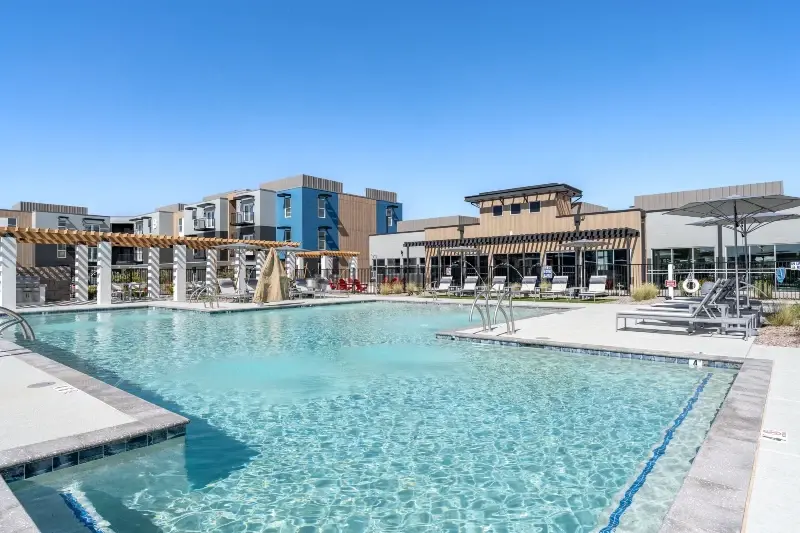
Z Modular isn't simply building faster or cheaper, though it does both. What sets it apart is operating as a fully integrated construction ecosystem at a time when most modular firms remain single-service providers.
As a subsidiary of Zekelman Industries, it controls its own steel supply chain, insulating it from the material delays, price volatility, and shortages that routinely derail competitors. Where others still rely on wood framing, Z Modular builds with steel-based modules, designed to deliver stronger, more durable mid-rise structures at scale.
Under the leadership of Nate Arnold, the company applies a standardized, factory-driven methodology that reduces risk, minimizes waste, and sharpens ROI without sacrificing quality or precision. At its manufacturing facilities in Chandler, Arizona and Killeen, Texas, modules arrive on-site up to 90% complete, dramatically compressing traditional construction timelines.
Skilled tradespeople work alongside automated production systems, and the proprietary Z Block connection system ensures structural integrity and precise alignment across every unit.
With housing shortages intensifying across the country, Z Modular's model is built for scale. Its FLATZ platform addresses low-rise residential communities, while FUZE targets mid-rise urban development, both designed to turn months, not years, into move-in-ready housing.
Modscape (Australia)
Founded in 2006 by architects and builders, Modscape identified a gap in the Australian market for high-quality, design-led prefabricated buildings and set out to fill it. From the very beginning, the company was built on a belief that thoughtful architecture and advanced off-site manufacturing could work hand in hand.
Over nearly two decades, that vision has grown into one of Australia's most trusted names in modular construction, with hundreds of completed projects spanning residential, commercial, education, and community sectors.

Modscape operates advanced manufacturing facilities across Victoria and Queensland, giving it the capacity and control to deliver at scale without sacrificing quality. Most notably, the company developed Modbotics, one of Australia's first in-house robotic manufacturing lines, purpose-built to bring unparalleled precision and consistency to every module produced.
This represents a highly industrialized approach to construction, not simply prefabrication adopted for convenience. The result is a proven delivery model that speaks for itself: homes completed in approximately 12 weeks from permit, with on-site installation often taking just days. That kind of speed is real-world execution, not theoretical promise.
Every project reflects a methodology refined over 20 years, one that balances architectural craftsmanship, sustainable materials, and cutting-edge technology.
Modscape embraces Modern Methods of Construction (MMC) not as a trend, but as the foundation of everything it does. Sustainability is woven into both the process and the product, ensuring that efficiency never comes at the expense of environmental responsibility. The company remains deeply committed to its founding vision: proving that prefab buildings can be intelligent, beautiful, and built to last.
At Modscape, innovation isn't a department, it's a culture, and it shows in every structure that leaves the factory floor.
The Future Is Modular
The five companies highlighted here represent more than just a list of capable builders, they reflect a fundamental shift in how the world approaches construction.
From Dragages Singapore's sustainable engineering milestones to Modscape's robotics-driven precision, and from Z Modular's vertically integrated steel ecosystem to Veev and SEA BOX's innovative, scalable platforms, each firm demonstrates that off-site construction has matured into a serious, high-performance discipline.
As labor shortages persist, sustainability mandates tighten, and housing demand continues to outpace traditional delivery methods, modular construction is no longer a workaround —it’s becoming a core solution. The companies bold enough to invest in factory precision, supply chain control, and design innovation today are the ones that will define the built environment of tomorrow.
In 2026 and beyond, the question for developers and contractors is no longer whether to go modular, but how quickly they can adopt it.


Comments